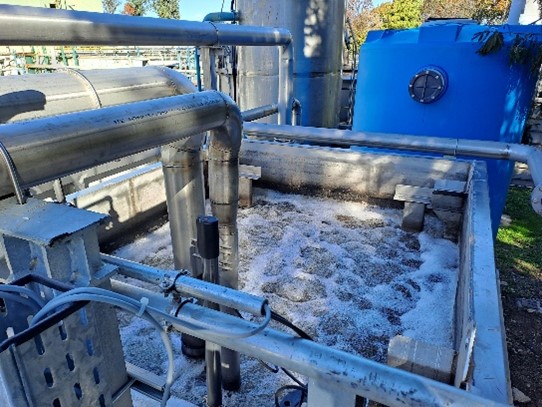
Membrane filtration systems
Membrane filtration systems, utilizing microfiltration (MF) and ultrafiltration (UF) technologies, offer a highly efficient tertiary treatment for wastewater, ensuring the almost complete removal of suspended solids, colloids, associated COD and bacteria.
By achieving high effluent quality standard, these systems make treated water perfect for reuse or safe discharge into surface water.
Microfiltration (MF) and ultrafiltration (UF) are also an ideal pretreatment for Reverse Osmosis (RO) plants, minimizing fouling while boosting performance and membrane longevity.
Suitable for both industrial and municipal wastewater treatment, they also represent a valid method for retrofitting existing plants, such as carbon or sand filters.
Overview
Show more Show lessThe filtration systems we provide, in collaboration with our partners, typically consists of:
- Pre-treatment with coarse and fine screening, as well as sand, oil and grease removal.
- Feed/lifting system to transfer water from the pre-treatment stage to the filtration unit.
- Membrane filtration unit, operating in various modes (feed & bleed, deposition, full drain) and configurations (side-stream, submerged, or hybrid) depending on specific needs.
- Recirculation and management system of concentrated wastewater.
- Permeate extraction and management system of filtered water toward discharge, reuse or to the reverse osmosis section.
- Membrane aeration system.
- CIP (Cleaning In Place) section with automatic and programmable washing cycles to reduce fouling and scaling.
A compact and robust system for consistent performance over time.
Features and rangeability
Show more Show lessWe design and size every system according to the specific type of water to be filtered, the upstream process and the client’s treatment objectives.
Main plant features:
- Configurations: side-stream, submerged or hybrid.
- Filtration modes: feed & bleed, deposition or full drain.
Membrane types: tubular ceramic membranes for microfiltration and hollow-fiber polymeric membranes for ultrafiltration.
Treated water characteristics:
- Concentration of suspended solids in contact with the membranes must not exceed a few g/l.
- Suspended solids removal down to TSS values ≤ 5 ppm.
The systems can be supplied in a compact and modular skid-mounted configuration or integrated into dedicated tanks (concrete or steel), depending on the size and layout. This ensures maximum installation flexibility for both new plants and retrofitting projects.
Key benefits
Show more Show less- Enhanced effluent characteristics
- Consistent effluent quality
- Modular and expandable design
- Compact footprint, ideal for retrofit installations with limited space
- Smooth integration into existing plants (revamping)
- Reduced environmental impact
- Water resource optimization, enabling high-quality water reuse
Applications
Show more Show lessPolishing of effluents, typically from secondary treatments, across a broad range of sectors:
- Chemical
- Food & Beverage
- Mining
- Pharmaceutical
- Power & Energy
- Textile & Tannery
- Municipal plants
The system can also be integrated with activated sludge biological treatments in MBR (Membrane Bioreactor) plants, providing efficient liquid-solid separation as an alternative to traditional sedimentation.
References