Back
|
Select another Case Study
Pharmaceutical ultrafiltration tertiary treatment
Context
Leading multinational pharmaceutical company aimed to improve the quality and consistency of the effluent at one of its production facilities.
The primary objective was to stabilize and enhance the quality of the effluent downstream of the existing secondary treatment stage (DAF – Dissolved Air Flotation) to minimize environmental impact and implement Best Available Technologies (BAT).
More specifically, the project required the reduction of suspended solids which had a fluctuating initial concentration reaching peaks of 50–100 ppm.
Challenges
- Inlet flows not inconsistent throughout the year.
- Potential presence of high temperatures requiring constant monitoring and control.
- System integration with existing plant infrastructure.
- Presence of an underperforming activated carbon tertiary treatment.
Our solution
Design
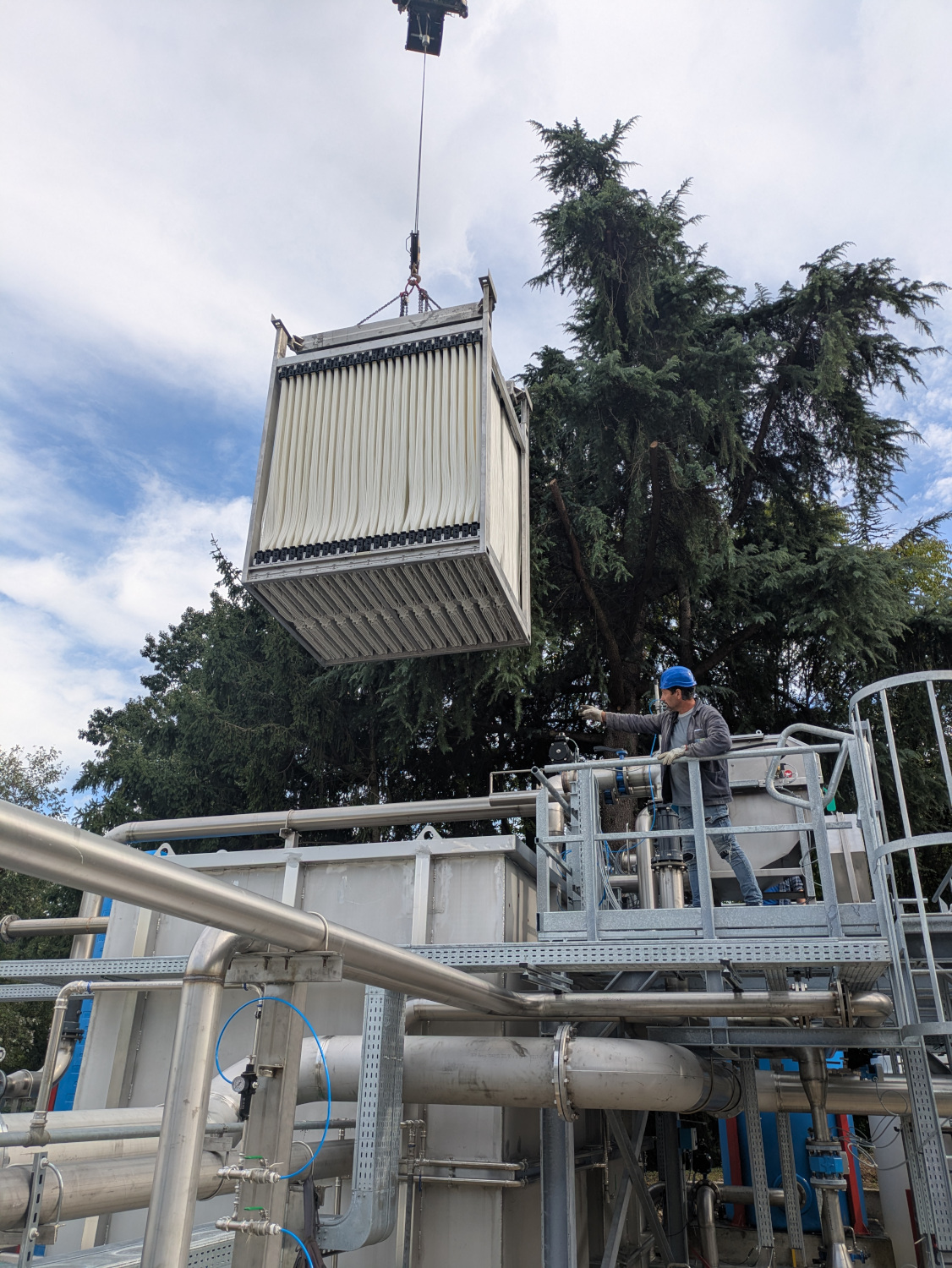
- Ultrafiltration treatment: unit with hollow-fiber membranes downstream of the DAF unit, replacing the existing activated carbon system.
- Performance Validation: on-site pilot plant testing conducted over a 3-month period to verify efficiency.
- Engineering & Sizing: custom design of the final plant based on raw water characteristics, experimental data from the pilot phase and specific site constraints.
Build
- Ultrafiltration Plant Construction:
- pre-treatment with 1 mm micro-strainer.
- filtration unit operating in both full drain and feed-and-bleed modes.
- aeration and automated cleaning systems.
- N+1 Configuration to warranty 100% process redundancy and to ensure continuous operation during cleaning or maintenance cycles.
Operate
- System Deployment: full installation and plant start-up (commissioning).
Key facts
- Country: Italy
- Year: 2025
- Industry: Pharma- CDMO
- Application: industrial wastewater treatment
- Wastewater: effluent from biological treatment + DAF
Scope of supply
- Plant: ultrafiltration with submerged hollow-fiber membranes
- Flowrate: 100 m3/h
- Target 1: 90% recovery rate
- Target2: TSS ≤ 5 mg/l.
Results
- Achieved and guaranteed performance.
- Project execution timing: 8 months