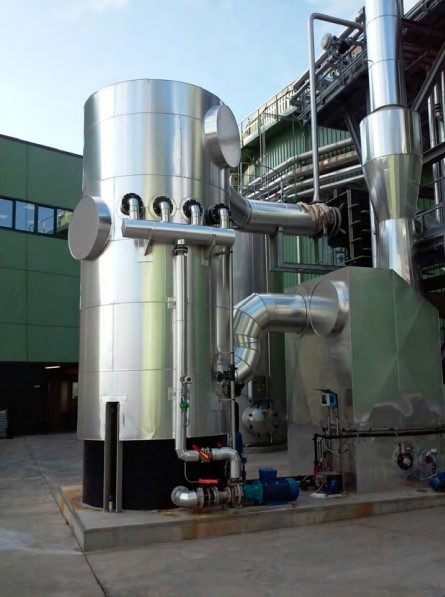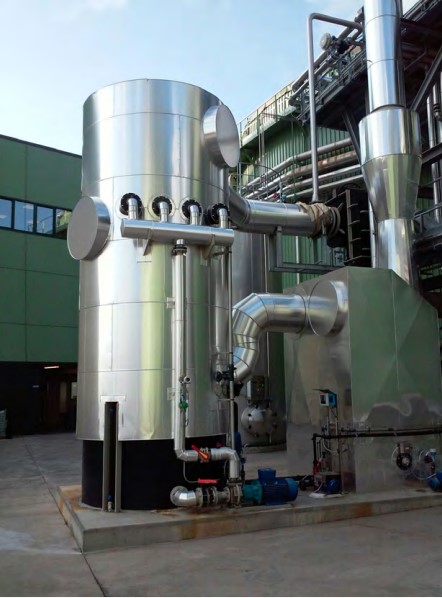
Stripping plant for ammoniacal nitrogen removal and recovery
Nitrogen is both a harmful pollutant when present in wastewater and a valuable nutrient widely used in fertilizers. Its removal and recovery from wastewater allow to pursue in one step multiple goals:
- comply with increasingly stringent nitrogen discharge limits
- improve operation performances of biological treatment plants
- reduce nitrous oxide emissions
- generate an alternative source of fertilizers
The process consists of the following main steps:
- converting nitrogen, present into the wastewater as dissolved ammonium ions, into free ammonia gas by increasing the pH
- enhancing ammonia volatilization by raising the wastewater temperature
- stripping out ammonia from wastewater through counter-current contact with air or steam, resulting in an “ammonia free” effluent
- absorbing stripped ammonia in an acid solution producing ammonia salts that can be recovered and reused as an agricultural fertilizer
As alternative it may be also possible to produce ammonia-rich water.
A simple and effective process also for highly contaminated industrial or municipal wastewater.
Overview
Show more Show lessThe Stripping Plant mainly consists of the following sections:
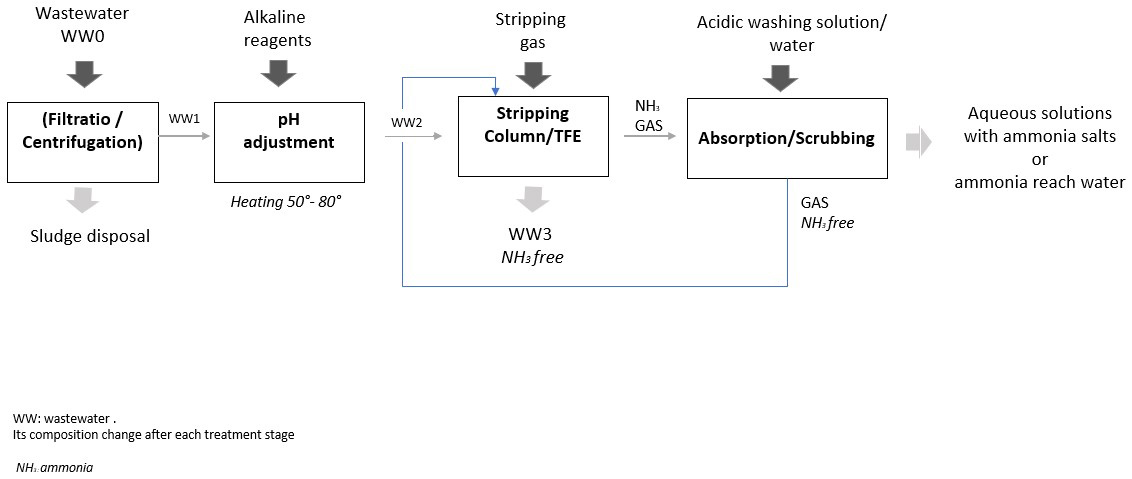
- Pre-treatment and pH adjustment
Filtration or centrigufation may be performed, as pre-treatment, in case of high content of suspended solids.
The liquid fraction is then storaged and pH value is optimized, typically using alkaline reagents as caustic soda.
Heat exchangers are in place in order to raise the wastewater temperature till optimal value for ammonia removal. On the other side of the exchangers, liquid temperature is lowered, enabling a possible energy recovery.
- Ammonia Stripping
The wastewar is pumped at the top of the stripping column and sprayed downwards.
A thin film evaporator ( TFE) may be used, as alternative to stripping column, in case of fouling streams.
Ammonia is stripped by air or vapour injection into the stripper with a fan and then recyled in a closed loop avoiding heat loss and odour emissions. The “ammonia free” effluent is discharged or undergo other treatments depending on the composition.
- Ammonia adsorption (scrubber)
The stripped ammonia is absorbed in an acid solution ( e.g sulphuric acid, phosporic acid) producing an aqueous stream with different ammonia salts depending on the acid used. Ammonia can be also stripped with steam and recovered as a concentrated
acqueous solution.
The plant can be equipped with a crystallizer for ammonium sulfate or other salts crystallization, depending on customer needs.
The stripping plant is typically part of the wastewater treatment train to reduce the nitrogen load on biological plants. It is particularly effective for lowering the nitrogen level in the anaerobic digesters, preventing toxicity and improving the digester performances.
We often combine the stripping unit with a wet oxidation plant for a highly efficient solution, not only for nitrogen recovery, but also for the removal of COD and highly refractory pollutants.

More about Wet Oxidation plants
Features and rangeability
Show more Show lessStripping plants are customized to meet customer’s needs and expectations.
Typical features are reported below:
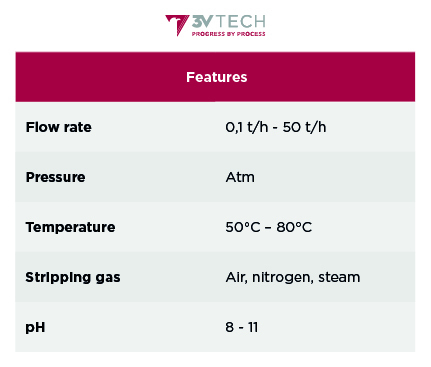
Different operating pressure, temperature and pH are properly defined based on the target to be achieved and trade-off with with operating costs .
Also supplied as skid-mounted units for easy installation and with dosing systems for cleaning solutions.
The most suitable material is selected depending on the nature of the wastewater, chemicals and operating conditions.
Typical used materials:
- Stainless steel
- PVC, PP, HDPE
- Nickel alloys (e.g., Hastelloy® HC22, Inconel® 600)
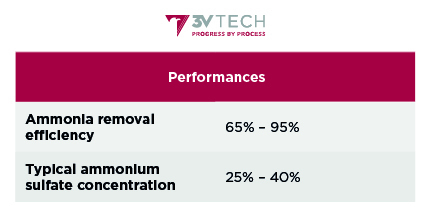
Depending on the acid solution used for scrubbing a different salt can be obtained.
A wide range of services from technical feasibility studies to revamping of existing plants are also available.
Key benefits
Show more Show less- Significant reduction of ammonia, even in highly contaminated wastewater
- Reduced footprint of biological treatment plants
- Lower nitrous oxide emissions
- Production of an alternative source of fertilizers, supporting the circular economy
- Improved performance of biological plants
- Modular and customizable design
- Easy integration with existing treatment facilities
Applications
Show more Show lessThe ammonia stripping plants are suitable for treating various kind of municipal and industrial wastewater, including landfill leachates and digestate from anaerobic digesters.
They may address the needs of multiple industries:
- Biogas production
- Chemical
- Food & Beverage
- Landfills
- Metal refining
- Multiutilities
- Petrochemical
- Pharmaceutical
Given the extensive wastewater compositions, generated by different industrial processes, we also provide support to our customers conducting tests at the laboratory and pilot plant scale, including feasibility studies, leveraging our R&D centre and multidisciplinary teams.
References